
Product Description
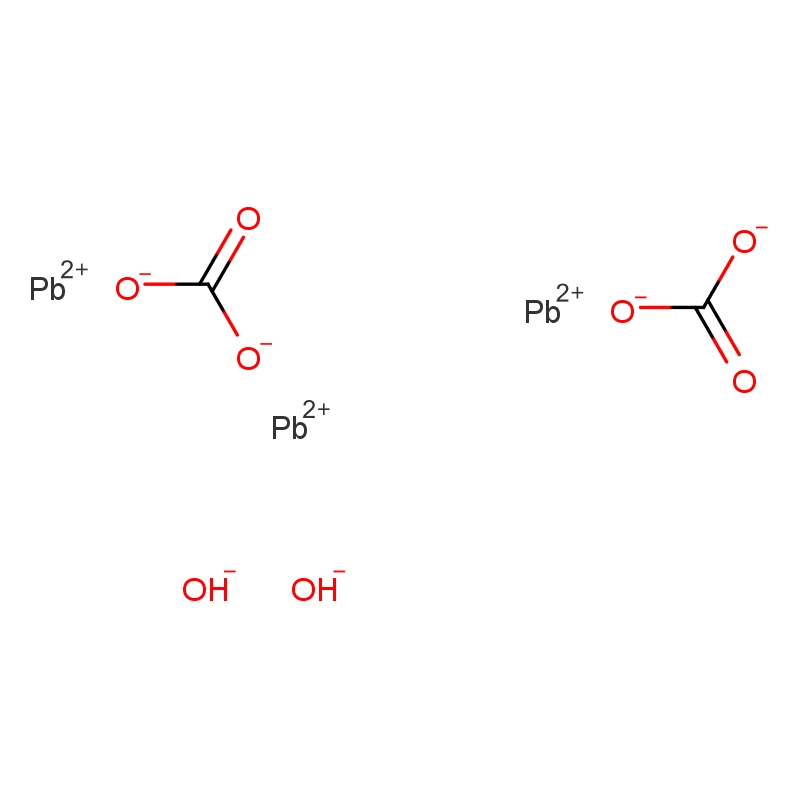
Lead(II) carbonate basic is a dense white powder with a hexagonal crystal system. It is insoluble in water and ethanol, but it can dissolve in strong acids such as acetic acid and nitric acid. The compound is stable under normal temperature and pressure conditions.
When heated at 220°C for about four hours, roughly 9% of its carbon dioxide content decomposes, and about 95% of the material is converted into PbCO₃·PbO. At 400°C, it undergoes further decomposition to form lead oxide with the release of carbon dioxide gas. Upon exposure to hydrogen sulfide, it slowly darkens, producing 4PbCO₃·PbS·Pb(OH)₂.
Factory Showcase
Chemical Properties
| Melting point | 400 °C (dec.)(lit.) |
| Density | 6,14 g/cm3 |
| Solubility | insoluble in H2O, ethanol; soluble in acid solutions |
| Form | Powder |
| Specific Gravity | 6.14 |
| Color | White to off-white |
| Water Solubility | Insoluble |
| Solubility Product Constant (Ksp) | pKsp: 13.13 |
| Exposure limits | ACGIH: TWA 0.05 mg/m3 NIOSH: IDLH 100 mg/m3; TWA 0.050 mg/m3 |
| Stability: | Stable. Incompatible with strong oxidizing agents, strong acids. |
| InChI | InChI=1S/2CH2O3.2H2O.3Pb/c2*2-1(3)4;;;;;/h2*(H2,2,3,4);2*1H2;;;/q;;;;3*+2/p-6 |
| InChIKey | RYZCLUQMCYZBJQ-UHFFFAOYSA-H |
| SMILES | C([O-])([O-])=O.C([O-])([O-])=O.[Pb](O)O.[Pb+2].[Pb+2] |
| CAS DataBase Reference | 1319-46-6(CAS DataBase Reference) |
| EPA Substance Registry System | Basic lead carbonate (1319-46-6) |
Inventory Display
Safety Information
| Hazard Codes | T,N |
| Risk Statements | 61-20/22-33-50/53-62 |
| Safety Statements | 53-45-60-61 |
| RIDADR | UN 2291 6.1/PG 3 |
| WGK Germany | 3 |
| RTECS | OF9275000 |
| TSCA | Yes |
| HazardClass | 6.1 |
| PackingGroup | III |
| HS Code | 28369917 |
| Hazardous Substances Data | 1319-46-6(Hazardous Substances Data) |
Product Application
Lead carbonate basic is characterized by a high refractive index and excellent weathering resistance, which makes it suitable for use in pigments, coatings, plastics, printing and dyeing processes, as well as analytical reagents. In the pigment sector, it is particularly valued for producing high-grade pearlescent pigments and is also used in formulating inorganic pigments for paints and coatings. In printing and ink applications, it is applied to various substrates including packaging paper, business cards, plastic fabrics, and textiles.
Transportation and Delivery