

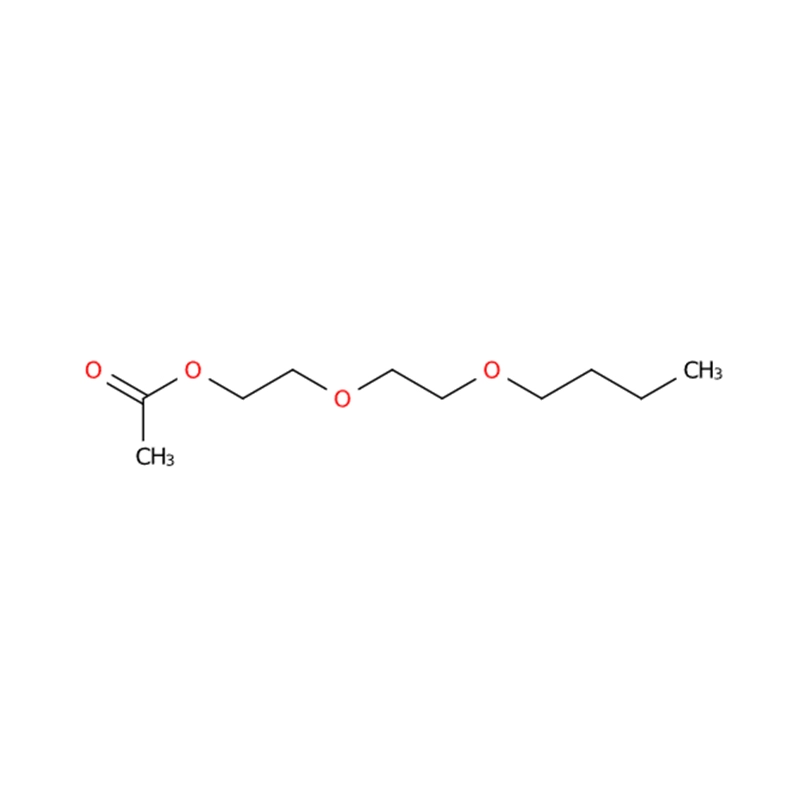
Product Description of Diethylene Glycol Butyl Ether Acetate CAS#124-17-4
2-(2-Butoxyethoxy)ethyl acetate, commonly referred to as Butyldiglycol acetate, functions as a valuable additive in the preparation of poly(vinyl acetate) (PVAc)-based composite films. By reducing the minimum film-forming temperature (MFT), it facilitates smoother and more efficient film formation.
In addition, this compound finds application in silver thick-film paste formulations, where it acts as an effective processing aid to support the demands of advanced material manufacturing.
Factory Showcase
Chemical Properties of Diethylene Glycol Butyl Ether Acetate CAS#124-17-4
| Melting point | -32 °C |
| Boiling point | 245 °C(lit.) |
| density | 0.977 g/mL at 20 °C(lit.) |
| vapor pressure | <0.01 hPa (20 °C) |
| refractive index | n20/D 1.426 |
| Fp | 105 °C |
| storage temp. | Store below +30°C. |
| solubility | water: soluble65g/L at 20°C |
| form | Liquid |
| color | Colourless |
| Odor | Mild, non-residual. |
| PH | 3-4 (50g/l, H2O, 20℃) |
| explosive limit | 0.76%, 135°F |
| Water Solubility | 65 g/L |
| BRN | 1771533 |
| Henry's Law Constant | 2.8×101 mol/(m3Pa) at 25℃, Duchowicz et al. (2020) |
| Stability: | Stable, but may be light sensitive. Combustible. Incompatible with strong oxidizing agents, acids, strong bases. |
| Cosmetics Ingredients Functions | VISCOSITY CONTROLLING |
| FRAGRANCE | |
| PERFUMING | |
| SOLVENT | |
| InChI | 1S/C10H20O4/c1-3-4-5-12-6-7-13-8-9-14-10(2)11/h3-9H2,1-2H3 |
| InChIKey | VXQBJTKSVGFQOL-UHFFFAOYSA-N |
| SMILES | CCCCOCCOCCOC(C)=O |
| LogP | 1.7 at 20℃ |
| CAS DataBase Reference | 124-17-4(CAS DataBase Reference) |
| NIST Chemistry Reference | Ethanol, 2-(2-butoxyethoxy)-, acetate(124-17-4) |
| EPA Substance Registry System | Diethylene glycol monobutyl ether acetate (124-17-4) |
| Hazard Codes | Xi |
| Risk Statements | 19-36/37-36 |
| Safety Statements | 39-26 |
| WGK Germany | 1 |
| RTECS | KJ9275000 |
| Autoignition Temperature | 393 °F |
| TSCA | TSCA listed |
Safety Information
| HS Code | 29153990 |
| Storage Class | 10 - Combustible liquids |
| Hazard Classifications | Eye Irrit. 2 |
| Hazardous Substances Data | 124-17-4(Hazardous Substances Data) |
| Toxicity | LD50 orally in Rabbit: 6500 mg/kg LD50 dermal Rabbit 5640 mg/kg |
Inventory Display
Product Application of Diethylene Glycol Butyl Ether Acetate CAS#124-17-4
Esters can react with acids, releasing heat and producing alcohols and acids as reaction products. Strong oxidizing acids may trigger vigorous reactions that generate sufficient heat to ignite the resulting materials. Heat may also be released when esters interact with caustic solutions.
Additionally, the reaction of esters with alkali metals and hydrides can produce flammable hydrogen gas.
Transportation and Delivery