

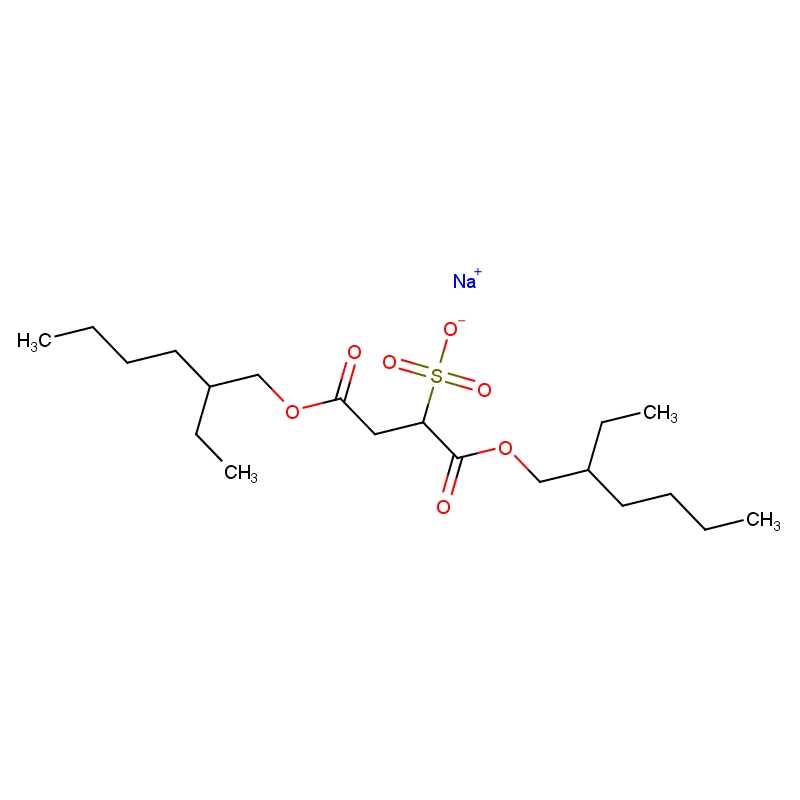
Products Description of Dioctyl Sulfosuccinate Sodium Salt CAS#577-11-7
Docusate sodium functions as a laxative and stool softener for the routine clinical management of constipation. Beyond gastrointestinal applications, it is also incorporated into the fabrication of electrospun fibers to achieve tailored, sustained release of antibiotic pharmaceuticals.
Factory Showcase

Dioctyl sulfosuccinate sodium salt Chemical Properties
| Melting point | 173-179 °C(lit.) |
| Boiling point | 82.7°C |
| Density | 1.1 |
| Vapor pressure | 0Pa at 25℃ |
| Storage temp. | Inert atmosphere,Room Temperature |
| Solubility | methanol: 0.1 M at 20 °C, clear, colorless |
| Form | Waxy Solid |
| Color | White |
| Specific Gravity | 1.005_PERCENT VOLATILE: 40 |
| Water Solubility | 1.5 g/100 mL (25 ºC) |
| Sensitive | Hygroscopic |
| λmax | λ: 260 nm Amax: 0.1 |
| λ: 280 nm Amax: 0.05 | |
| Merck | 143,401 |
| BRN | 4117588 |
| Stability | Stable. Combustible. Incompatible with strong oxidizing agents. |
| InChIKey | APSBXTVYXVQYAB-UHFFFAOYSA-M |
| LogP | 1.998 at 20℃ |
| CAS DataBase Reference | 577-11-7(CAS DataBase Reference) |
| EPA Substance Registry System | Bis(2-ethylhexyl) sodium sulfosuccinate (577-11-7) |
Safety Information
| Hazard Codes | Xn,Xi |
| Risk Statements | 22-38-41-36/37/38 |
| Safety Statements | 26-39-37/39-36 |
| WGK Germany | 2 |
| RTECS | WN0525000 |
| F | 3-10 |
| TSCA | Yes |
| HS Code | 29171900 |
| Hazardous Substances Data | 577-11-7(Hazardous Substances Data) |
| Toxicity | LD50 oral in rat: 1900mg/kg |
Inventory Display
Product Application of Dioctyl Sulfosuccinate Sodium Salt CAS#577-11-7
As a laxative and stool softener, docusate sodium treats constipation and is used to make electrospun fibers for regulated, customizable antibiotic delivery. In textiles, it delivers excellent permeability and wettability, serving as an effective emulsifier, detergent, penetrant, thickener and wetting agent.
Commonly named Aerosol OT, it acts as a lubricant and multi-purpose surfactant widely used in printing, dyeing and cosmetics as emulsifier and wetting agent. Mixtures of docusate sodium and CAPSO form microemulsion electrophoresis systems to test natural and synthetic estrogens. It can produce reversed-phase microparticles in hydrocarbon solvents and dissolve most membrane proteins. Besides printing and dyeing applications as surfactant, penetrant, emulsifier and leveling agent, it is also an emulsion raw material for photosensitive materials.
Transportation and Delivery